


How do you find subjects?

Updated: Jul 17
This would be my personal answer, but from conversations I suspect it’s a question that quickly goes away once you’ve taken the plunge and started painting or sketching regularly. 'Inspiration' is an odd concept and possibly even a myth when it comes to painting. You can just go ahead and paint and the more you do it the better you get at it. I'm most often inspired simply by the look of the watercolours in my palette.

If you paint often enough you’ll probably have the opposite problem to ‘finding subjects’, you’ll be seeing them everywhere. One of the things that differs between painting and photography is that the end result is in larger part due to how the painting looks than what the subject was. Painters can also adjust any subject or its lighting to a degree that would make Photoshop jealous. So the subject isn’t so much the be-all-and-end-all of a painting. Counter-intuitive perhaps, but avoiding "painting the postcard view" is usually good advice. For one thing, it'll have been done before and that invites instant comparison with a hundred other versions. Also it instantly makes the painting about how well the subject is rendered, rather than about your style and approach (which is where the fun lies). Another 'Dunottar Castle' is likely to be seen as just that, however good your work is. So unexpected subjects often have a surprising appeal.

I find much of the attractiveness of a painting is in the look of the pigments on the paper, with their colour and texture and then the shape and size of brushstrokes that make up an image. Also in the ‘running joke’ of how the brushstrokes make up the image by suggesting figures and elements in the scene while not individually looking like much. I say joke because I find there’s something of the feeling of a punchline, or that moment of solving a crossword clue, when you see how an image has been assembled. At the same time you perceive the intended effect and can switch between the illusion and the mechanics of how it was produced. This works on the painter painting as much as on the viewer viewing and is surely one of the addictive delights of painting.

For me what makes a good subject is the opportunity to use paint to create the illusion or impression of a visual experience. Often that depends on the presence or possibility of interesting tonal contrasts, whether in lighting or colour, and shapes that look like they’ll be fun to paint. By ‘possibility’ I mean that a strong contrast, like a dark shadow or burst of colour, could be added and look credible even if there isn’t one at the time I’m painting. Usually if something is enjoyable or interesting to paint it is enjoyable to look at as a painting, and I’m not entirely sure why that is but it seems to be the case. Just what makes a painting attractive enough to want to have on the wall might be a big subject -no pun intended.
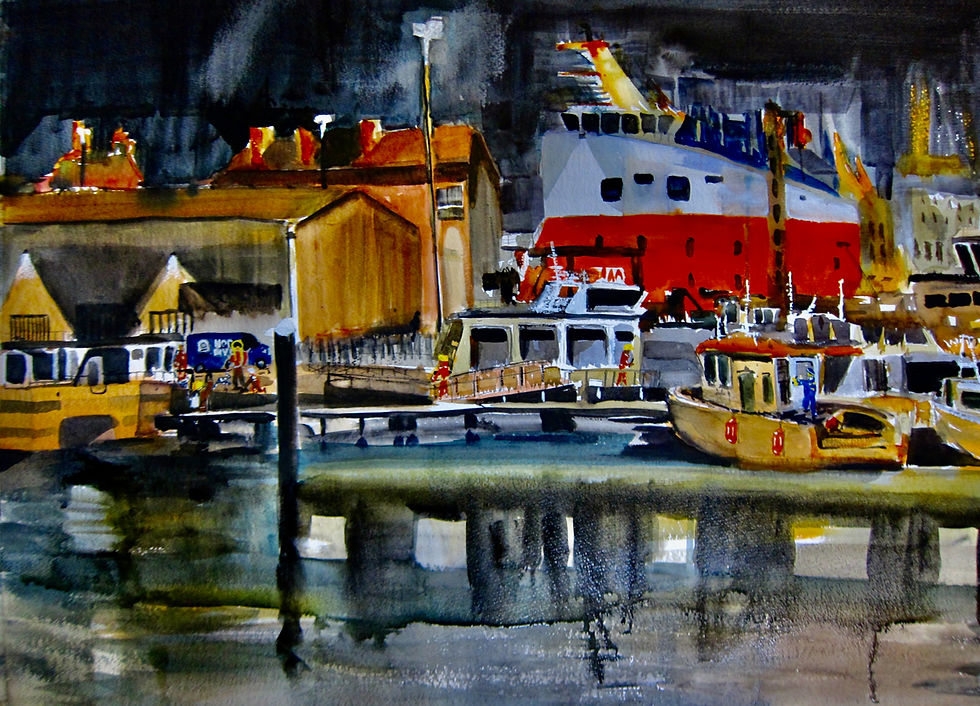
I go out and paint without consciously considering subject choices too much as I so much enjoy the process of putting watercolour on paper. I realised it didn't matter to me what I was painting, as long as I was painting, and only later noticed that often the 'boring' subjects gave me my better paintings.

When I started painting from life (en plein air as we say) at first I did seek out specific subject scenes, but eventually hit on painting the first thing that caught my eye in a place -and rationalised that I'd get to any other candidates on one of my next visits. That way I could start painting quickly without fear of missing out on what was round the next corner. I would also find myself painting in the same place again with a different composition, or painting it again in different light, and not even thinking of it as “the same subject”. Again, as I was painting I’d come to choices as to how to tackle an element of the painting and want to come back and take the other option, so potential scenes were effectively multiplying in front of me.
I count line and wash urban sketching as an extension of watercolour and I think that contributed to my enjoyment of painting "the ordinary stuff” -all those alleys and bins and cars etc., and being surprised how good they often look in watercolour. If I'm unable to go out or don't have a specific thing in mind to paint, I'll happily fill sketchbook pages with the elements I've felt I need to get more comfortable with - cars, figures, trees, and so on. So I really feel I run without a stock of ideas, or lists, or choices to make and there just seems to be a momentum in keeping on painting for the sheer joy of it.


If you hesitate in the slightest over spoiling or 'wasting' your materials, buy some cheaper ones you can be relaxed about -student materials, sketchbooks, budget paper -and just deliberately use them as fast as you can. A sketchbook is a a great de-stresser as there's no sense of your painting or sketch having to be a magnificent object, it's just a page in a rough book that will be battered and stained by the time it's finished. (Often, quite attractively so! )
So don't worry about subjects, or fret about inspiration, or suffer artist's block, just paint ...anything. Free yourself from your own expectation of a masterpiece every time and approach blank paper as a rehearsal space. Enjoy putting paint on it. Give it your best shot and if the result is great, congratulations!
Happy Painting!


I like how you shift the focus from the subjects to the enjoying the act of painting as your motivation, Danny. That's a very liberating approach.
Well said!
Thanks for this, it sounds so simple when you say it, Danny. We put ourselves under so much pressure don't we, but like the Nike slogan, "Just do it!".